



General information on "American" Wisteria
FassadenGrün helps you to select Wisteria from our range. The term "American" wisteria is used here to describe the types that originate from North America and are used on façades. They tend to grow moderately strongly and are only moderately dense with flowers. However, they hardly cause any structural damage, require less pruning than "Asian" wisteria and are easier to handle. And they are also suitable for "mixed greening"!
>>> Price list
(Wisteria frutescens // Wisteria macrostachya)

To thrive...
Warm, somewhat wind-protected, absolutely full-sun locations. Hardly any flowering in partial shade. Deep, humus-rich soil with a good water supply. Planting distance: 2 - 5 m.
Properties
Medium-strong, healthy climbing plants up to approx. 10 m in height. Feathery leaves, foliage from May to November, no significant autumn colouring. No flower buds from the previous year! The flowers develop at the ends of the new shoots, therefore main flowering only in May / June. Flowering time is often identical with the rival lilac flower. The flowers are said to be edible, as a fresh salad or as baked "doughnuts" (no guarantee). Usually re-flower twice, sometimes until October. Brown, hairless legumes, which are poisonous.
Training
As with the "Asian" wisteria, it makes sense to build up a sparse trunk framework. This can be vertical and horizontal "spindles" or angular shapes, each with short side branches. However, free fan shapes analogous to vines are just as possible.
Pruning
"American" wisteria responds well to "caretaker" pruning: Everything that grows out of the trunk framework is shortened vigorously and evenly in winter. Of course, like "Asian" wisterias, they can also be pruned to "cones" for the sake of clarity. However, this has no advantages for flower formation. Summer pruning is only necessary if the foliage development becomes too strong. There is a risk that shoots with valuable re-flowers will be cut away.
Climbing Aids for the Façade
Pole-like trellises, adapted to the height and width of growth. Rather linear, but also flat, preferably not wooden trellises. All FassadenGrün series are suitable. Wire ropes are also suitable, especially heavy / massive kits. In private gardens (constant supervision), medium-sized "Classic" kits are possible, but the ropes should be maintained once a year and, if necessary, slackened by loosening the grub screws (see photos below). Alternatively, the trunk structure can be strictly parallel without wrapping as described for the "Asian" Wisteria. Simple "Basic" kits may also be possible for potted plants. See below for suitable arrangements of rods and ropes.

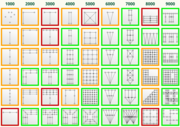


Wire Rope Systems compatible with "American" Wisteria
Please click on the graphic illustrations for details!
| = suitable | = of limited suitability | = unsuitable |


