



Mixed Greening with Climbing Plants
Several climbing plants on one wall ~ is that possible? Can you create a multi-coloured wall garden? But of course ~ as long as the plants you choose thrive in the same conditions and can grow compatibly side by side without growing significantly into each other. It gets more complicated with the latter scenario when plants on the same support system and same section of wall intertwine. Here we'll share with you a few good plant combos and ways to combine them.

Side by Side and Intertwining
Various climbing plants -- be they woody perennials, herbaceous perennials, or annuals -- can easily co-existence on your facade. Maybe you've seen such combinations from display gardens, where various types of grapevines and roses, for example, grow happily side by side.
One has to be aware, however, of the growth habit and vigour of each of the plants, as the more vigorous climbers (silver lace vine (Fallopia baldschuanica), wisteria, clematis vitalba) will readily overgrow and smother the others. Pruning back the different plants with their individual requirements ('species-specific cut') becomes more difficult when their shoots have become intertwined. We recommend planting the plants in separate planting holes or well separated from each other in a planting trench. If there is only one planting hole available, it is best to keep the rootballs of the individual plants separated by root barriers.


Leafy Plants and Flowering Plants
Some climbing plants have wonderfully lush foliage (resulting in high surface coverage) but are reticent when it comes to blooming. It makes sense then to combine the '5-star' leafy climbers with flowering friends. Most popular vines are the ivy(Hedera helix), Virginia creeper (Parthenocissus quinquefolia 'Engelmannii'), woodbine (Parthenocissus vitacea), Bostonivy (Parthenocissus tricuspidata) or the grapevine (Vitis vinifera), which are then combined with flowering annuals. These can be grown in separate pots, watered and fertilised separately, removed yearly in late autumn, and brought out again in spring for re-planting. Where large facades are greened with self-clinging climbers, flower (window) boxes can provide beautiful splashes of colour.


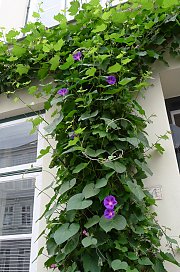

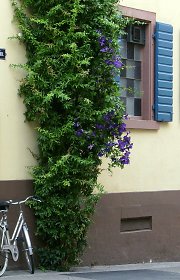

Various Flowering Plants
A much loved and undeniable duo are the clematis and climbing rose. Annual climbers can also be easily combined. The art lies in coordinating their flowering times ~ so, chooding the species that allow for either a simultaneous blooming or one that is staggered.


