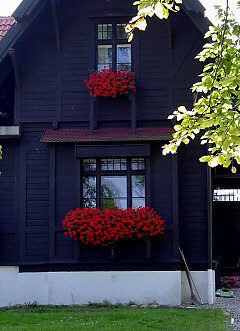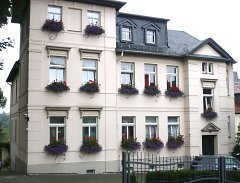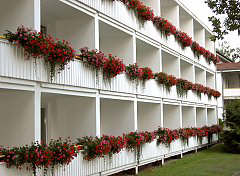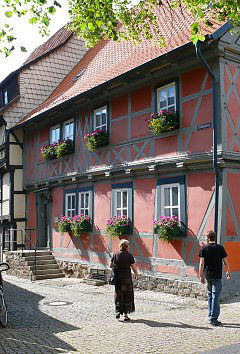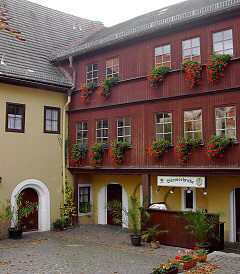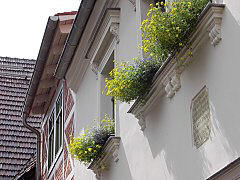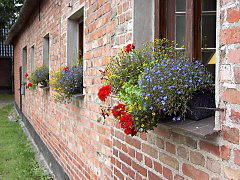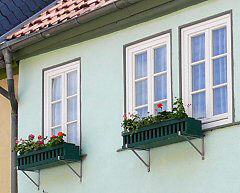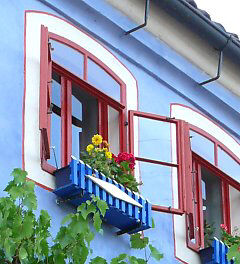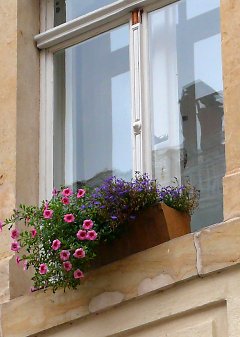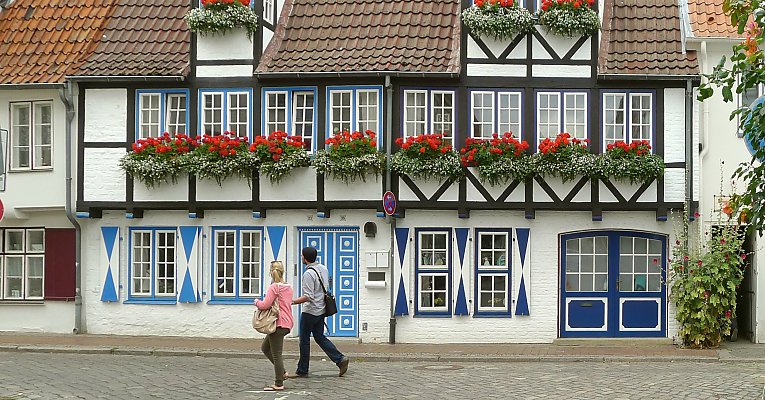



It is almost always pelargoniums that can be found on window sills. They bloom for months and are extremely robust, so they can tolerate little water. Even over 100 years ago, they were all the rage for beautifying facades! Their radiance and the associated long-distance effect are simply unbeatable. But no one can offer everything, and so the main problem with pelargoniums is that they are only annuals in our latitudes and are difficult to overwinter. Normally, all boxes are therefore replanted in the spring. What happens to the plant boxes in winter? Either they are completely cleared or planted with winter heather (Erika carnea) and other plants. Sometimes fir greenery is also added.
Depending on the desired effect, there are three types: firstly, upright varieties (Pelargonium zonale); secondly, so-called 'hanging pelargoniums' (Pelargonium peltatum) with delicate, star-shaped flowers, also known as ‘ivy pelargoniums’ or ‘peltatum hybrids’; and thirdly, a mixed form, which are ‘semi-trailing’ or ‘broad-growing’ pelargoniums (Pelargonium interspecific). These form longer shoots than the first type, and these shoots can then also overhang and cover the flower pot, for example. However, the shoots do not reach the length and fullness of hanging geraniums.
The different types can be combined. The particularly large-flowered noble pelargoniums (Pelargonium grandiflorum), with their velvety soft, serrated leaves, need a sheltered spot or are used indoors. They do not cope well with bright sun, wind and rain.
Unfortunately, pelargoniums are not “insect plants”, but sometimes this can be an advantage. The fragrant spice pelargoniums (Pelargonium crispum) are particularly repellent and can be mixed in plant boxes on the windowsills of a hotel. Why? Sometimes there are allergic guests who cannot tolerate insect bites but still want an open window with beautiful flowers. So: pelargoniums offer hardly any nectar or pollen, but perhaps one day newly bred varieties will be able to remedy this situation.
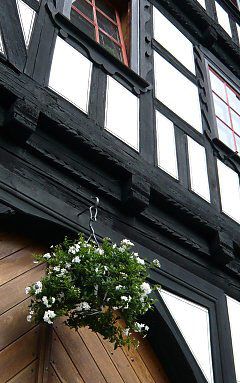
If you want your plants to grow downwards for a particularly long time, there is no way around the hanging species and hybrids of the ‘Plectranthus’ group. The German names are as varied as the Latin names (Plectranthus glabratus or Plectranthus coleoides “Varigatus” or Plectranthus forsteri). The ‘harp bush’ is particularly suitable for greening façades, as its many shoots, which hang down almost parallel to the ground, actually resemble the vertically stretched strings of a harp. Other names include “incense” or ‘moth king’, as these plants repel insects such as mosquitoes with their slightly spicy scent and are therefore particularly valuable in front of windows. The somewhat stiff, shrubby hanging shoots grow up to 1.5 m in a season, sometimes even up to 2 m. The shoots form a kind of ‘mat’ and are therefore not immediately tangled and swirled by the wind like some other species. Sometimes there are flowers, but they hardly play a role outdoors on the wall.
Plectranthus can be combined excellently with all three types of pelargoniums (see above) and grows significantly longer than “trailing pelargoniums” (Pelargonium peltatum).
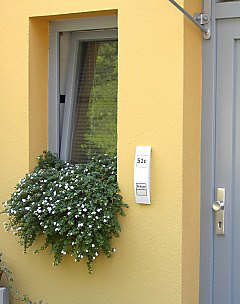
What other plants are there? Petunias (Petunia) are extremely prolific bloomers and complement the colour palette of geraniums, especially with their lilac-blue varieties. Here, too, there are upright and hanging types, known as “trailing petunias”. The same applies to dipladenias (Dipladenia) and fuchsias (Fuchsia). For yellow tones, there is, for example, ‘Zweizahn’ or Goldmarie (Bidens ferulifolia), and for blue tones, a vigorous fan flower variety (Scaevola aemula “Blue Wonder” or similar). The latter should be planted separately in boxes, as they prefer a slightly acidic environment. They are low-maintenance and self-cleaning. Begonias (Begonia) provide a profusion of flowers for shady locations.
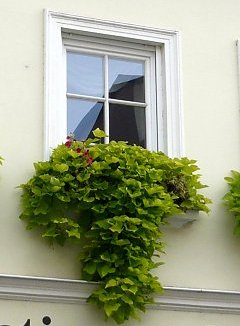
A counterpoint to all the many colours is the leafy sweet potato (Ipomoea batatas) with its light green leaves. There is also a dark variety, the “purple sweet potato”. The “silver rain” (Dichondra argentea), on the other hand, is more delicate but thrives with little water. Its shoots quickly become entangled by the wind, forming long ‘beards’. All these species are ‘summer plants’ and are essentially annuals.
Shrubby and hanging plants are often combined. Ideally, for ‘lots of mass’, the boxes are wider and planted in two rows, with the hanging plants in the outer, front row and the others behind them. In general, filling the boxes is an art that requires a lot of experience and, if there is pressure to succeed, should be left to a professional gardener.
Nevertheless, here's a tip: if geraniums and petunias are combined, the latter should be planted in smaller numbers due to their overwhelming abundance of flowers if a balanced appearance is desired.
Although rather unusual, it is also possible to plant hanging plants such as cotoneaster, euonymus and winter jasmine all year round. In wind-protected, not too warm locations, even ivy is an option. However, you will have to do without colourful flowers.
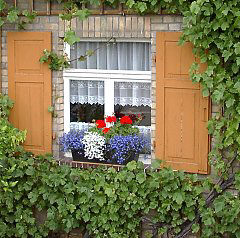
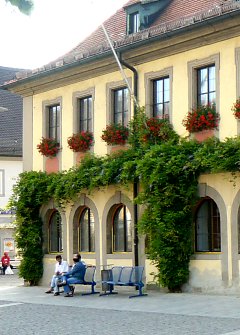
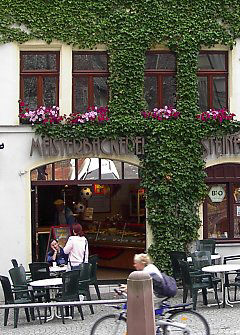
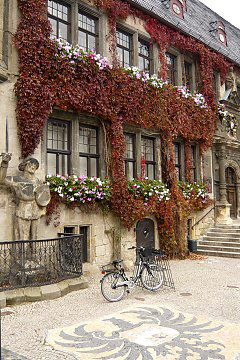
Flower boxes can also be combined with façade greening! This can be done with either partial greening or full greening. The latter usually forms a single-colour green carpet, with the flower boxes adding splashes of colour. If the ‘green carpet’ consists of wild vine (Parthenocissus) or ivy (Hedera), for example, and is therefore bee-friendly, less insect-friendly plants can also be tolerated in the flower boxes because the overall ecological balance is right, so to speak.
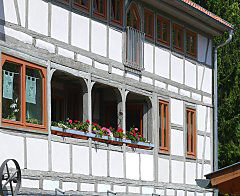
Does Every Window Have its Box ? As a rule, small arrangements aren't impressive when designing window boxes, because a single flower box on a big wall usually gets lost. Aesthetically, it is better to install several, or at least to do so at all windows on one storey/level. Naturally, fitting all the windows of a facade with flower boxes creates the most unified appearance.
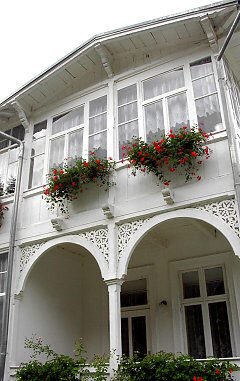
Most flower boxes today are made of plastic, but you'll still find them in sheet metal, steel, or special woods. Some have cleverly designed water storage and fertilisation-- even automated greening systems.
Flower boxes are usually mounted on an existing window sill. If a sill is not available, a bracket can be mounted on the outer wall, or planter support brackets / grids can be screwed on.
During a storm, these window boxes can be blown away, especially if they are old or dried out (and therefore light). Various devices help to prevent this: horizontal protective rods screwed onto the wall, protective boards, or sturdy protective gratings.